



How Does Leasing a Silverado 1500 Work?
A Silverado 1500 lease payment mainly covers the difference between the truck’s adjusted capitalized cost and its residual value, spread over the term, plus a finance charge. Here’s what each lease term means:
| Lease Term | What It Means |
|---|---|
| Gross capitalized cost | The agreed price of the truck plus any fees or add-ons rolled into the lease |
| Cap-cost reduction | Cash, trade equity or applicable incentives applied up front |
| Adjusted capitalized cost | The gross capitalized cost minus any cap-cost reduction |
| Residual value | An estimate of what the truck will be worth at lease end, set by the leasing company rather than by you |
| Money factor | A factor used to calculate the finance charge, written as a small decimal rather than an APR |
| Term | The length of the lease, agreed in your contract |
| Mileage allowance | The miles your contract allows over the term, chosen at signing |
| Excess-mile charge | A per-mile charge at lease end for miles over the allowance, set in your contract |
| Wear and use | Damage beyond normal wear, as your contract defines it, which can be charged after the turn-in inspection |
| Acquisition fee | A fee some leases charge at the start to set up the lease |
| Disposition fee | A fee some leases charge at turn-in if you return the truck |
When a Silverado 1500 lease ends, your options depend on your contract and the leasing company’s policies. You may return the truck, buy it at the purchase price your contract sets, or trade it toward another vehicle. Read your contract well before the last payment so you know which options you have.
Should I Lease or Finance a Silverado 1500?
Leasing and financing a Silverado 1500 differ on each of these points:
| What You’re Comparing | Leasing | Financing |
|---|---|---|
| What you pay for | Part of the truck’s value over a set term | The whole price of the truck |
| Ownership | The truck isn’t yours unless you buy it at lease end | The truck is yours |
| Miles | A mileage allowance set in your contract, with a per-mile charge for miles over it | No lease mileage allowance |
| Condition | Damage beyond normal wear can be charged at turn-in | No lease turn-in inspection |
| Modifications | Check your contract before adding aftermarket equipment | No lease turn-in terms to plan around |
| At the end | Depending on your contract, return the truck, buy it at the price the contract sets, or trade it | You keep the truck |
The way you drive usually points toward a lease or a loan.

The Commuter
A lease is worth pricing out if your mileage is predictable and you’d like a newer truck when the lease ends. Look at financing instead if your miles are hard to predict.

The Weekend Boater
A lease may still work if you pull a boat to the St. Johns River on weekends and the rest of your driving stays predictable. Look at financing instead if your towing is heavy or frequent.

The Work Truck
Financing often fits better when the truck goes to job sites every day. High work miles and job-site wear push against a lease’s limits. A lease can still work if your work miles are predictable and the truck stays close to how it left the factory.

The Keeper
Financing usually fits if you plan to keep the truck long after a lease would have ended or add aftermarket equipment along the way. A lease can still work if you’d rather decide later, since your contract may let you buy the truck at lease end.

Which Silverado 1500 Trims Make Sense to Lease?
Deciding which trim of the Silverado 1500 to lease comes down to the starting price you want your lease built on and whether you want a lift from the factory. A lower starting price is a lower starting point for the gross capitalized cost. If you want a lifted truck, the Custom Trail Boss, LT Trail Boss and ZR2 come with the lift installed at the factory, so there’s no aftermarket lift to check against your lease contract.
The 2026 Silverado 1500 trims line up by starting price:
| Trim | Starting MSRP at Launch | Factory 2-Inch Lift |
|---|---|---|
| WT | $36,900 | - |
| Custom | $42,400 | - |
| LT | $47,900 | - |
| RST | $51,300 | - |
| Custom Trail Boss | $52,900 | Yes |
| LTZ | $58,000 | - |
| LT Trail Boss | $59,700 | Yes |
| High Country | $62,900 | - |
| ZR2 | $71,800 | Yes |
Starting MSRP at Launch excludes destination freight charge, tax, title, license, dealer fees and optional equipment.
Equipment varies by trim, so see what each one includes in our 2026 Silverado 1500 overview before you choose, then browse Silverado inventory for the trim that fits.
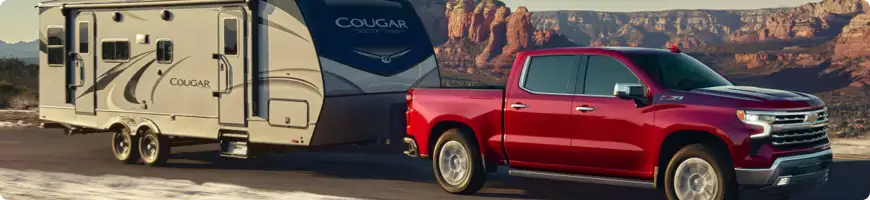
Leasing a Truck for Towing and Work Around Northeast Florida
Towing, work miles and aftermarket changes each add something to plan for on a Silverado 1500 lease.
Every mile counts toward your allowance: Towing and work miles count against your mileage allowance the same as commuting miles. A commute across the Buckman Bridge adds miles, and so do weekend boat trips to the St. Johns River, Doctors Lake or Black Creek. Choose an allowance at signing that covers trailer trips and job-site runs along with your daily driving.
Heavy towing adds wear: Heavy or frequent towing adds wear and use to a truck. If you tow often, read your contract’s wear-and-use terms before you sign.
Aftermarket changes need a contract check: A hitch added later, a lift, bed equipment or racks may affect the truck’s condition at lease end or need to come off before you turn the truck in. Check your lease contract before you change anything. Equipment installed at the factory is part of the truck as built, not an aftermarket change. That includes the Max Trailering Package for heavy towing and the lift on the off-road 2026 Silverado Trail Boss trims and the 2026 Silverado ZR2.
Aftermarket parts and the warranty: Equipment from independent suppliers isn’t covered by the GM New Vehicle Limited Warranty. That’s true whether you lease or finance.

What Sets My Silverado 1500 Lease Payment?
These are the main things that set a Silverado 1500 lease payment:
The truck’s price: The trim and equipment you choose set where the price starts. The price you agree on goes into your gross capitalized cost. With all other terms equal, a lower adjusted capitalized cost means a lower payment.
Your down payment or trade equity: Cash or trade equity applied up front comes straight off the gross capitalized cost, bringing it down to the adjusted capitalized cost.
The residual value: A higher residual, which the leasing company sets, leaves less of the truck’s value for you to pay for.
The money factor: The money factor is used to calculate the finance charge, so ask for it and compare it.
The term: The length of the lease you agree to sets how many payments the difference between the adjusted capitalized cost and the residual is spread across.
The mileage allowance: The allowance you choose at signing affects the payment.

What Does the Factory Warranty Cover on a Leased Silverado 1500?
The factory warranty on a 2026 Silverado 1500 starts on the date the truck is first delivered or put in use. Bumper-to-bumper and powertrain coverage have separate limits, and the powertrain limit depends on the engine:
| Coverage | Applies To | How Long |
|---|---|---|
| Bumper-to-bumper | The complete truck, with some exclusions | 3 years or 36,000 miles, whichever comes first |
| Powertrain | 2.7L TurboMax and Duramax 3.0L Turbo-Diesel engines | 5 years or 100,000 miles, whichever comes first |
| Powertrain | 5.3L and 6.2L EcoTec3 V8 engines | 5 years or 60,000 miles, whichever comes first |
Which engines a given truck can have depends on its trim and configuration. A lease term may fall within this coverage, so compare your term and mileage allowance with where each coverage ends before you sign. That tells you whether any part of your lease would fall outside it.

How Do I Get Started at Gordon Chevrolet?
Gordon Chevrolet is the Home of No Bull Pricing: competitive prices, no huge add-on stickers or equipment packages, no gimmicks or games, and trades wanted but not required. When you’re ready to weigh a Silverado 1500 lease against a loan, start with these steps:
- Before you choose, see current new-vehicle specials.
- To work out a payment on your own, estimate a payment.
- If you have a vehicle to trade in, value your trade-in.
- To know where you stand before you shop, get pre-qualified.
- To lease or finance with us, start at our finance center.
Frequently Asked Questions
Generally, yes. Towing miles count against your mileage allowance like any other miles, and heavy or frequent towing adds wear and use. If you tow often, pick an allowance with room for it and read the contract’s wear-and-use terms before you sign.
Check your lease contract first. A hitch added later, a lift or bed equipment may affect the truck’s condition at lease end or need to come off before turn-in. Equipment from independent suppliers also isn’t covered by the GM New Vehicle Limited Warranty. If you want a lifted truck from the start, the Custom Trail Boss, LT Trail Boss and ZR2 are the off-road trims with a factory-installed 2-inch lift.
Often, but it depends on your contract. Under the leasing company’s policies, you may buy the truck at the purchase price your contract sets, return it, or trade it toward another vehicle. Some leases charge a disposition fee if you return the truck, so check your contract.
Financing often fits a high-mileage work truck better. Work miles count against a lease’s mileage allowance, and job-site damage beyond normal wear can be charged at turn-in. Racks or bed equipment added later may also need to be removed before you return the truck. A financed truck has no lease limits on any of that.
Bumper-to-bumper coverage runs 3 years or 36,000 miles, whichever comes first. Powertrain coverage runs 5 years or 100,000 miles, whichever comes first, on the 2.7L TurboMax and the Duramax 3.0L Turbo-Diesel. On the 5.3L and 6.2L EcoTec3 V8 engines, it runs 5 years or 60,000 miles, whichever comes first. Coverage starts on the date the truck is first delivered or put in use, and a lease term may fall within it.