Open TodaySales: 9 AM-7 PMOpen TodayService: 7 AM-6 PM
2026 Chevrolet Silverado Trail Boss: Custom vs LT
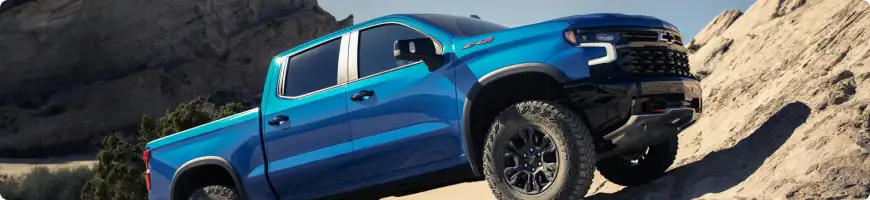
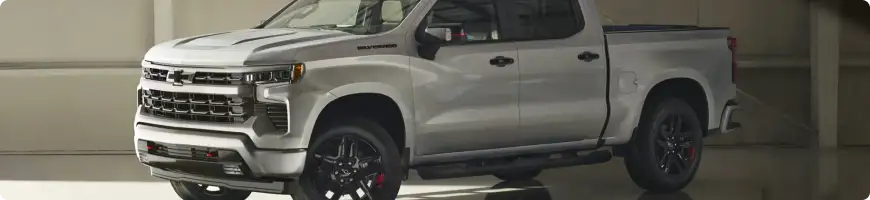
The Trail Boss is the lifted, off-road version of the Chevrolet Silverado 1500, and for 2026 it comes in two trims, so
shopping one in Northeast Florida starts with picking between them. The Custom Trail Boss starts at $52,900 and the LT Trail
Boss at $59,700, a gap of $6,800 (starting MSRP at launch, 2026 model year, excluding destination). Both leave the factory as
four-wheel-drive Crew Cabs, with the same 2-inch suspension lift, the same monotube shocks, and the same red recovery hooks.
Trail Boss is not a badge added to a Silverado 1500. It is one factory suspension package, and only these two trims are
built with it. Chevrolet's order guide states the package contents in a single line: off-road suspension with a 2-inch lift
and monotube shocks, Hill Descent Control, skid plates, a heavy-duty air filter and a Z71 hard badge. Three more pieces of
hardware come as standard trim equipment alongside it.
Off-Road Hardware
How It Comes on a Trail Boss
Off-road suspension with a 2-inch lift and monotube shocks
In the factory suspension package
Hill Descent Control
In the factory suspension package
Skid plates
In the factory suspension package
Heavy-duty air filter
In the factory suspension package
Z71 hard badge
In the factory suspension package
Auto-locking rear differential
Standard trim equipment
2-speed electronic Autotrac transfer case
Standard trim equipment
Red recovery hooks
Standard trim equipment
Every line of that list arrives on both grades, so nothing about the lift or the stance changes between them.
Two off-road packages, one truck: Chevrolet also sells a separate Z71 Off-Road Package on other Silverado
trims, and it is not the same equipment. That one brings off-road suspension, Hill Descent Control, skid plates and a
heavy-duty air filter, with no lift and no monotube shocks, and Chevrolet does not offer it on a Trail Boss at all. The lift
and the shocks arrive only in the package both Trail Boss trims already carry, which is the whole reason the trim exists.
The lift is the part you see from the curb, and Chevrolet's own dimensions tables put a figure on it. These are
four-wheel-drive Crew Cab numbers, the lifted column against the standard one.
Four-Wheel-Drive Crew Cab
Standard
Trail Boss (Lifted)
Ground clearance, short bed
8.08 inches
11.1 inches
Ground clearance, standard bed
7.95 inches
11.0 inches
Overall height, short bed
75.51 inches
78.35 inches
Overall height, standard bed
75.4 inches
78.23 inches
Body style: The Trail Boss comes as a four-wheel-drive Crew Cab and nothing else. Chevrolet offers both
trims on four-wheel-drive Crew Cab models only, so there is no Double Cab Trail Boss and no two-wheel-drive Trail Boss. That
one body style decides more than the stance, as the trailering answer below shows.
Custom Trail Boss vs LT Trail Boss
The two starting prices do not cover the same engine. The lower grade is a 2.7L TurboMax truck, while the higher one is
built with the 5.3L V8, the 6.2L V8 or the 3.0L Duramax, so part of what the step up buys is engine and the rest is
equipment. Each Trail Boss grade is built on the standard trim of the same name, and stepping from Custom to LT adds seven
things as standard equipment.
Feature
Custom Trail Boss
LT Trail Boss
Touchscreen
7-inch
13.4-inch premium touchscreen with navigation and Google built-in
Climate control
Single-zone manual
Dual-zone automatic
Headlamps
Halogen
LED
Entry and start
Key-fob remote entry
Keyless Open and Start with push-button start
Driver display
3.5-inch
12.3-inch reconfigurable digital display
Bumpers
Black
Chrome
Door handles
Black
Body-color
Both trims keep the same 40/20/40 split-bench front seat, so the step up is about screens, comfort, and finish rather than
seating.
On top of that standard equipment, the higher grade can also be ordered with the LT Trail Boss Premium Package, which the
lower one cannot. It bundles Convenience Package II, a Safety Package, a Leather Package, a Protection Package, and a power
up/down tailgate.
Which trim should you choose: Custom or LT Trail Boss?
Trail Boss Grade
MSRP at Launch
Best For
Custom Trail Boss
$52,900
Getting into the factory lift for the lower price, when a 7-inch screen and halogen headlamps are enough, and it is
the one of the two offered with the 2.7L TurboMax
LT Trail Boss
$59,700
Wanting the bigger screens, LED headlamps, dual-zone climate, and push-button start as standard, and it is the only
one of the two that can be ordered with the Premium Package or the 6.2L V8
MSRP at launch (2026 model year), excluding destination.
The off-road hardware is settled before you pick a grade, so the deciding question is whether the screens, lighting, climate
control, and entry system you live with every day are worth the step up in price, whether you want the Premium Package on
the table at all, and, if you have your heart set on the 6.2L V8, which of the two can be ordered with it.
Silverado 1500 Engine Range
The Trail Boss draws from the Silverado 1500 engine lineup, which offers four engines for 2026.
Engine
Type
Horsepower
Torque
On a Trail Boss
2.7L TurboMax
4-cylinder
310 hp
430 lb-ft
Included on the Custom Trail Boss; not offered on the higher grade
5.3L V8
8-cylinder
355 hp
383 lb-ft
Available on both trims, with dual exhaust on the higher one
6.2L V8
8-cylinder
420 hp
460 lb-ft
Available on the LT Trail Boss only
3.0L Duramax
6-cylinder turbo-diesel
305 hp
495 lb-ft
Available on both trims
The two trims do not draw on that list the same way, so the engine you want can decide the trim for you. The Custom Trail
Boss is a 2.7L TurboMax truck with the 5.3L V8 and the 3.0L Duramax open to it, and the 6.2L V8 is not offered on it at all.
The LT Trail Boss goes the other way: it is built with the 5.3L V8, the 6.2L V8 or the 3.0L Duramax rather than the 2.7L
TurboMax.
On fuel economy, the four-wheel-drive Silverado 1500 runs from 17 to 24 MPG combined depending on the engine: the V8s sit at
the lower end, and the 3.0L Duramax turbo-diesel returns the best combined figure at 24. Those are model-level figures,
since the EPA rates fuel economy by engine and drivetrain rather than trim by trim, so there is no Trail Boss-specific
rating. The 24 MPG is the standard four-wheel-drive diesel figure; the ZR2 rides on 33-inch mud-terrain tires and extra
off-road gear, which drag its mileage lower.
Where It Sits in the Lineup
Chevrolet builds nine Silverado 1500 trims for 2026. Three of them leave the factory with the 2-inch lift.
Trim
Starting MSRP at Launch
Factory 2-Inch Lift
WT
$36,900
No
Custom
$42,400
No
LT
$47,900
No
RST
$51,300
No
Custom Trail Boss
$52,900
Yes
LTZ
$58,000
No
LT Trail Boss
$59,700
Yes
High Country
$62,900
No
ZR2
$71,800
Yes
MSRP at launch (2026 model year), excluding destination.
One thing to watch on that list: Chevrolet uses the Custom and LT names twice, once on the standard trucks and again on the
two Trail Boss trims. A Custom is not a Custom Trail Boss, and an LT is not an LT Trail Boss. The Custom Trail Boss opens
the lifted range, sitting directly above the RST, which is not lifted, while its LT counterpart lands between the LTZ and
the High Country, neither of which is lifted. Only the ZR2, at $71,800 at launch, is lifted and priced higher.
We sell the 2026 Silverado Trail Boss in Orange Park, to buyers from across Northeast Florida. Gordon Chevrolet is the
Home of No Bull Pricing: competitive prices, no huge add-on stickers or equipment packages, no gimmicks or games, and
trades wanted but not required.
Trail Boss names the lifted, off-road version of the Chevrolet Silverado 1500. For 2026 it comes in two grades, Custom
and LT Trail Boss, and both are four-wheel-drive Crew Cabs. The 2-inch suspension lift, the monotube shocks, the skid
plates and the red recovery hooks are installed at the factory rather than added to the truck afterward.
The off-road hardware is the same on both, so nothing about the lift or the stance changes when you move up. What
changes is equipment and price: the lower grade launched at $52,900, the higher one at $59,700 (starting MSRP at
launch, 2026 model year, excluding destination). Because the higher grade is built on the LT trim, it comes standard
with a 13.4-inch touchscreen, dual-zone automatic climate control, LED headlamps, Keyless Open and Start, a 12.3-inch
digital driver display, and chrome bumpers, where the lower one has a 7-inch screen, single-zone manual air
conditioning, halogen headlamps, and black bumpers. Only the higher grade can be ordered with the LT Trail Boss
Premium Package.
Yes, and it is the only way the truck is built. Chevrolet offers both grades on four-wheel-drive Crew Cab models only,
and both come with the 2-speed electronic Autotrac transfer case.
The highest ball-hitch rating in the Silverado 1500 range is 13,300 pounds, and it is a lineup figure rather than a
Trail Boss one. It belongs to a single setup: a two-wheel-drive Double Cab with the standard bed, the 3.0L Duramax
turbo-diesel and the Max Trailering Package. Chevrolet builds the Trail Boss only as a four-wheel-drive Crew Cab, and
that package cannot be ordered on either one, so 13,300 pounds is not the number to plan a lifted truck around.
Chevrolet rates trailering by configuration rather than trim by trim, so the ratings that apply to a Trail Boss are
the four-wheel-drive Crew Cab ratings without that package.
Engine and Rear Axle, Four-Wheel-Drive Crew Cab
Short Bed
Standard Bed
2.7L TurboMax, 3.42 axle
9,000 pounds
9,000 pounds
5.3L V8, 3.23 axle
9,300 pounds
9,200 pounds
6.2L V8, 3.23 axle
9,100 pounds
9,100 pounds
3.0L Duramax, 3.23 axle
9,000 pounds
9,000 pounds
The 6.2L V8 row applies to the higher trim, the only one of the two it can be ordered on. Chevrolet calculates these
maximums on a standard-equipped truck plus a driver and the required trailering equipment, so passengers, cargo, and
options all take weight back off. Bring us the loaded weight of what you plan to pull and we will check it against the
rating on that specific truck.
Torque is what pulls a loaded trailer away from a stop, and the 3.0L Duramax turbo-diesel makes the most of it at 495
lb-ft, while the 6.2L V8 makes the most horsepower at 420. Those two engines are the ones behind the lineup's biggest
trailering numbers, but every one of those numbers depends on the Max Trailering Package, which is not offered on
either Trail Boss trim. On the four-wheel-drive Crew Cab a Trail Boss is built on, without that package, the 5.3L V8
with the 3.23 axle carries the highest published ball-hitch rating of the four engines: 9,300 pounds with the short
bed and 9,200 pounds with the standard bed.
It brings the trailer hitch, a 7-pin connector and a 4-pin connector, and Hitch Guidance. On a truck ordered with the
5.3L V8 it also calls for the auto-locking rear differential, and it comes as part of the WT Value Package.
Yes. The trailer brake controller is a standalone option, and a truck ordered with one also needs the Trailering
Package.
Yes. The National Highway Traffic Safety Administration (NHTSA) scores the Silverado 1500 by cab style and drivetrain
rather than by trim, so the scores that apply to a Trail Boss are the Crew Cab's, in four-wheel drive: 5 stars in the
side crash test, 4 stars in the frontal crash test, and 4 stars for rollover resistance, with an overall score of 4
stars.
Both are lifted, and the gap between them is narrower than the price suggests. A Trail Boss brings the 2-inch lift,
monotube shocks, skid plates, Hill Descent Control, an auto-locking rear differential and the 2-speed transfer case,
and in short-bed form its ground clearance is 11.1 inches against the ZR2's 11.22 inches.
What the ZR2 adds on top is hardware neither Trail Boss trim carries: front and rear electronic locking differentials
(E-lockers) and Multimatic DSSV dampers. It launched at $71,800, against $52,900 and $59,700. If the factory lift, the
locking rear differential and the skid plates cover what you actually do with the truck, a Trail Boss is the one to
look at. The full lineup overview covers the ZR2 and both Trail Boss trims:
2026 Silverado 1500 Lineup Overview.