Sales:
(904) 592-3846
Service:
(904) 592-3831
Parts:
(904) 592-3799
Open Today Sales: 9 AM-7 PMOpen Today Service: 7 AM-6 PM




The 2026 Chevrolet Equinox and 2026 Honda CR-V are two of the more cross-shopped compact SUVs, close in mission but built to different strengths. The Equinox leads with more torque, a simpler lineup, and No Bull pricing. The CR-V counters with more cargo room and a hybrid option that reaches 40 mpg combined.
Neither out-classes the other across the board, so the choice comes down to whether the Equinox's torque and value matter more to you than the CR-V's room and efficiency.

The Equinox and CR-V trade the two headline numbers, with the CR-V making more horsepower and the Equinox more torque. The Equinox's 1.5-liter turbocharged four makes 175 horsepower and 184 lb-ft in front-drive form, rising to 203 lb-ft with all-wheel drive. The CR-V's 1.5-liter turbo makes 190 horsepower but 179 lb-ft, so the CR-V holds the horsepower edge while the Equinox pulls a little harder at low speeds, and noticeably harder once you add all-wheel drive.
| Engine | Equinox | CR-V |
|---|---|---|
| Type | 1.5L turbo 4-cyl | 1.5L turbo 4-cyl / hybrid |
| Horsepower | 175 | 190 (gas) / 204 (hybrid) |
| Torque (lb-ft) | 184 FWD / 203 AWD | 179 (gas) |
| Transmission | CVT / 8-speed auto (AWD) | CVT |
The CR-V also offers something the Equinox does not: a hybrid. The CR-V Hybrid pairs a gas engine with electric motors for 204 total horsepower, which makes it both the strongest and the most efficient CR-V. The Equinox keeps to one turbocharged engine, running a continuously variable transmission in front-drive and a conventional 8-speed automatic when you add all-wheel drive.

The CR-V is the more efficient of the two, and its hybrid widens that gap considerably. A front-drive gas CR-V is rated at 28 mpg city and 33 highway, ahead of the front-drive Equinox's 26 and 29. The CR-V Hybrid goes further still, at 43 city and 36 highway, a level no gas Equinox reaches.
| Configuration | City / Highway |
|---|---|
| Equinox front-drive | 26 / 29 |
| Equinox all-wheel drive | 25 / 29 |
| CR-V gas, front-drive | 28 / 33 |
| CR-V Hybrid | 43 / 36 |
All-wheel drive is available on both and trims fuel economy a little on each. The point is straightforward: the CR-V is the more efficient choice, the hybrid decisively so, and fuel economy is one area where the Equinox does not lead.

The CR-V is the roomier of the two, with its clearest advantage in cargo. Behind the rear seats the CR-V holds 39.3 cubic feet to the Equinox's 29.8, and with the seats folded it opens to 76.5 cubic feet against the Equinox's 63.5. That is a meaningful gap if you regularly carry larger or bulkier loads.
| Measure | Equinox | CR-V |
|---|---|---|
| Passenger volume | 104.3 cu ft | 106 cu ft |
| Cargo, behind rear seat | 29.8 cu ft | 39.3 cu ft |
| Cargo, seats folded | 63.5 cu ft | 76.5 cu ft |
Passenger space is much closer, 104.3 cubic feet in the Equinox and 106 in the CR-V, so both seat five in comfort. The clearer difference is cargo, where the CR-V's extra room with the seats down is the standout.

Both come with a standard suite of driver-assistance features, so safety technology is well covered on either one. The Equinox includes Chevy Safety Assist as standard, covering automatic emergency braking, front pedestrian braking, and lane keep assist with lane departure warning, with features like adaptive cruise control available higher up. The CR-V includes Honda Sensing.
On screens, the Equinox holds the size advantage, pairing an 11.3-inch touchscreen with Google built-in against the CR-V's 9-inch display. Both cover the safety features compact-SUV shoppers expect, so beyond the screen the tech decision comes down to which conveniences are bundled at the trim you are comparing.
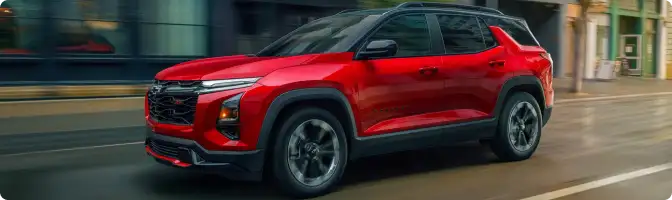
The two take different approaches to their lineups. The Equinox keeps it simple with three trims, LT, RS, and ACTIV, spanning a well-equipped base, a sporty RS look, and a rugged-styled ACTIV, all from one turbocharged engine. The CR-V runs a longer lineup that splits across gas and hybrid trims, from the LX up through the hybrid Sport Touring, which gives it more variety along with a wider price spread.
Where the Equinox makes its strongest case is value. A straightforward lineup and No Bull pricing aim to put a well-equipped compact SUV in your driveway without a long climb up the trim ladder, and that, with its torque and available all-wheel drive, is the core of its case against the roomier CR-V with its longer, more varied lineup.

What a spec chart cannot show is the part that decides a lot of compact-SUV purchases: the price, and how straightforward the dealership makes it. Ours is No Bull, a competitive number with no add-on stickers, no forced packages, and nothing added at the close. You can bring a trade, but you do not need one for us to give you a figure.
New Equinox buyers also get free paintless dent repair through the first 90 days, which takes the first door ding off your worry list. It is one more reason the money-saving end of Blanding Blvd is worth the drive for families across Clay County, Green Cove Springs, and the greater Jacksonville area.
If the trim or color you want is not on the lot, we can source one or build it to your preferences with our Chevrolet configurator, and the full Chevrolet SUV lineup is there if you are still comparing sizes. Before you visit, you can value your trade or request a no-obligation cash offer, plan a monthly payment, and get prequalified with no impact to your credit score. Other comparisons are on our Chevrolet comparisons page, and current 2026 Equinox inventory shows what is ready now.
When it comes down to the Equinox and the CR-V, driving the Equinox is the fastest way to know whether its value and pull fit what you need.
A few questions settle most Equinox-versus-CR-V decisions.
The CR-V, at 190 horsepower to the Equinox's 175. The Equinox's counter is torque, where it leads, especially with all-wheel drive, so it pulls harder at low speeds even though the CR-V has the bigger horsepower number.
The Equinox. It makes 184 lb-ft with front-wheel drive and 203 with all-wheel drive, both ahead of the CR-V's 179 lb-ft. The all-wheel-drive Equinox holds the clearest torque advantage of the two.
The CR-V, and the hybrid widens the gap. A gas front-drive CR-V rates 28 mpg city and 33 highway to the Equinox's 26 and 29, and the CR-V Hybrid reaches 43 and 36, which no gas Equinox matches. Fuel economy is the CR-V's category here.
Yes. The CR-V Hybrid makes 204 total horsepower and is the most efficient version, at 40 mpg combined. The Equinox is offered only with its gas turbocharged engine, so if a hybrid is a must-have, the CR-V is the one that offers it.
The CR-V, by a clear margin. It holds 39.3 cubic feet behind the rear seats to the Equinox's 29.8, and 76.5 cubic feet with the seats folded to the Equinox's 63.5. If maximum cargo room is a priority, the CR-V leads.
They are close, with the CR-V slightly ahead, 106 cubic feet of passenger volume to the Equinox's 104.3. Both seat five comfortably, and riders are unlikely to notice the difference.
Yes. Both the Equinox and the CR-V are available with all-wheel drive, and on each it trims fuel economy slightly compared with the front-drive version. The Equinox also gains torque in its all-wheel-drive setup, rising to 203 lb-ft.
The Equinox keeps it to three: LT, RS, and ACTIV. The CR-V runs a longer lineup split between gas and hybrid trims, from LX up through the hybrid Sport Touring. The Equinox is the simpler lineup; the CR-V offers more variety and the hybrid option.
The Equinox includes Chevy Safety Assist, with automatic emergency braking, front pedestrian braking, and lane keep assist with lane departure warning. The CR-V includes Honda Sensing. Both make their core safety suite standard from the base trim.
At Gordon Chevrolet in Orange Park, on the Blanding Blvd corridor and a short trip from Fleming Island, Middleburg, and the greater Jacksonville area. Tell us which trims you are weighing, and we will have an Equinox ready so you can compare it against the CR-V in person.