Sales:
(904) 592-3846
Service:
(904) 592-3831
Parts:
(904) 592-3799
Open Today Sales: 9 AM-7 PMOpen Today Service: 7 AM-6 PM




The 2026 Chevrolet Colorado runs one turbocharged engine, one cab, and one bed, and asks you to pick a trim rather than a configuration. The 2026 Toyota Tacoma takes the opposite approach, with 2 engines, 2 cab styles, 2 bed lengths, and 8 trims. That split between focus and choice runs through almost every part of this comparison, and it points the trucks at slightly different buyers even though they sit in the same class and chase the same work.
The short version: the Colorado pulls more, comes better equipped on its standard screen, and keeps the lineup simple. The Tacoma offers a hybrid, more ways to spec the truck, and a slight edge on payload and base fuel economy. Where you land depends on whether you value a heavier tow rating and a simpler choice, or the widest set of build options in the segment.

The Colorado out-tows the Tacoma, while the Tacoma reaches a higher peak horsepower. Every 2026 Colorado uses one 2.7-liter turbocharged 4-cylinder, tuned to 237 horsepower and 259 lb-ft in standard form and 310 horsepower and 430 lb-ft in High-Output form. That available output beats the Tacoma's base i-FORCE engine outright. The Tacoma's top setup, the i-FORCE MAX hybrid, then leapfrogs it at 326 horsepower and 465 lb-ft. So the Colorado's stronger engine clears the Tacoma's base engine, and the Tacoma's hybrid clears the Colorado's stronger engine.
Towing is where the Colorado pulls ahead and stays there. A properly equipped Colorado is rated to 7,700 pounds. The Tacoma tops out at 6,500 pounds with the i-FORCE engine and lands near 6,000 with the hybrid. Payload runs the other way by a hair: the Colorado carries up to 1,684 pounds, and the Tacoma reaches roughly 1,705.
| Specification | 2026 Colorado | 2026 Tacoma |
|---|---|---|
| Engines | One 2.7L turbo (2 outputs) | i-FORCE 2.4L turbo + i-FORCE MAX hybrid |
| Horsepower | 237 std / 310 High-Output | up to 278 (i-FORCE) / 326 (MAX) |
| Torque (lb-ft) | 259 std / 430 High-Output | up to 317 (i-FORCE) / 465 (MAX) |
| Max towing | 7,700 lbs | 6,500 lbs (i-FORCE); ~6,000 (MAX) |
| Max payload | 1,684 lbs | up to ~1,705 lbs |
| Transmission | 8-speed automatic | automatic (manual on select i-FORCE) |
For most buyers the practical read is simple. If the number that matters is how much you can pull behind the truck, the Colorado has the higher ceiling. If you want the strongest engine in either lineup or a hybrid option, that is the Tacoma.
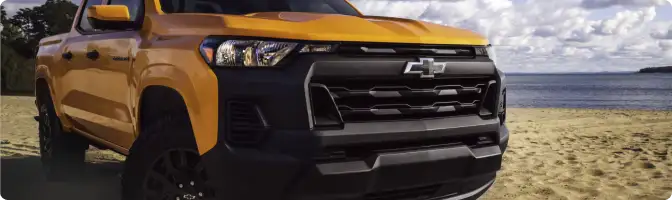
The trucks differ most in how many ways you can build them. The Colorado comes one way mechanically: a crew cab with a 5-foot, 2-inch short box, a single engine family, and 5 trims that change equipment and off-road hardware rather than the body. The Tacoma is the opposite, offering a choice of cab, a choice of bed, a choice of engine, and 8 trims.
| Build option | 2026 Colorado | 2026 Tacoma |
|---|---|---|
| Cab styles | Crew Cab only | XtraCab or Double Cab |
| Bed lengths | 1 (5'2" / 61.7 in) | 5-ft or 6-ft |
| Engine choices | 1 (2.7L turbo) | 2 (i-FORCE, i-FORCE MAX hybrid) |
| Trims | 5: WT, LT, Trail Boss, Z71, ZR2 | 8: SR to Trailhunter |
Neither approach is automatically better. The Colorado's single configuration removes decisions and keeps a consistent footprint across the lineup, which is part of why its bed and cab dimensions stay the same from the work truck up to the ZR2. The Tacoma's menu lets a buyer match the truck to a narrow need, a longer 6-foot bed for hauling, a tighter XtraCab for a daily, or the hybrid for the most output. If you already know exactly how you will use the truck, the Tacoma's range can fit it more precisely. If you would rather pick a trim and be done, the Colorado is built for that.
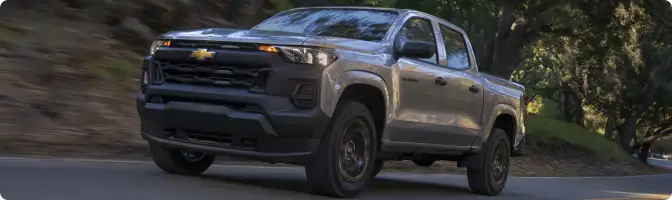
Fuel economy between these two is close, with a slight edge to the Tacoma at the efficient end and a range advantage to the Colorado. A rear-drive Colorado is EPA-rated at 21 mpg combined (19 city, 24 highway). Four-wheel-drive versions drop to 19 combined, the off-road trims with mud-terrain tires to 18, and the ZR2 to 17. The Tacoma's most efficient setups land slightly higher, with the rear-drive SR and SR5 rated up to 23 combined, and the i-FORCE MAX hybrid near 21 combined in four-wheel drive.
| Configuration | Combined MPG |
|---|---|
| Colorado 2WD | 21 |
| Colorado 4WD | 19 |
| Colorado ZR2 4WD | 17 |
| Tacoma SR/SR5 2WD (i-FORCE) | up to 23 |
| Tacoma i-FORCE MAX 4WD | ~21 |
One number that runs in the Colorado's favor is the tank. It holds 21.3 gallons against the Tacoma's 18.2, so even at similar economy the Colorado can cover more distance between stops, which matters on longer hauls down US-17 or toward the coast. The takeaway: pick the Tacoma if peak mpg is the priority, the Colorado if you would rather stop less often.

Both trucks field serious off-road trims, and both back them with real hardware rather than appearance packages. The Colorado's answer is the ZR2, which adds Multimatic DSSV dampers, locking front and rear differentials, up to 10.7 inches of ground clearance, and a 38.3-degree approach angle. The Trail Boss and Z71 sit below it with their own raised suspensions and the G80 limited-slip rear differential.
The Tacoma counters with the TRD Off-Road, TRD Pro, and Trailhunter trims, the last two built around heavier suspension and recovery-focused equipment for tougher trails. Both trucks can be ordered to handle far more than a graded fire road, so the decision here tends to come down to which brand's off-road setup and trim walk-up you prefer rather than a single spec. If you want the locking differentials and the long-travel dampers in one package, the Colorado ZR2 puts them together near the top of its range.
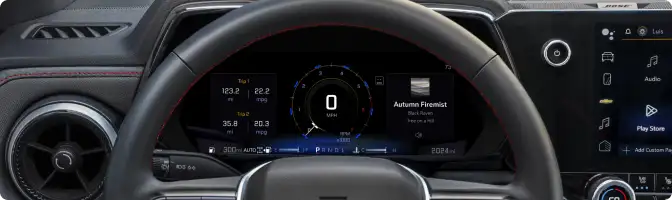
The Colorado leads on the standard screen, while the Tacoma offers a larger one as an upgrade. Every Colorado includes an 11.3-inch color touchscreen with Google built-in and an 11-inch driver display, so the larger interface and connected apps are there from the work truck up. The Tacoma starts with an 8-inch touchscreen and offers a 14-inch unit higher in the range, which tops the Colorado's screen for buyers who step up to it.
On driver assistance, both are evenly matched in intent. The Colorado comes with Chevy Safety Assist as standard, a package that bundles automatic emergency braking, lane keep assist, forward collision alert, and related features. The Tacoma includes Toyota Safety Sense 3.0, which covers the same ground with its own pre-collision and lane systems. Neither truck offers hands-free highway driving, so both keep the driver hands-on at all times.
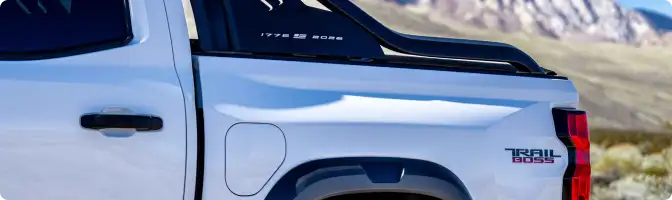
A spec table narrows this choice; a test drive settles it. Loading the bed, sitting in the crew cab, and feeling how the turbo pulls is what tells you whether the Colorado fits the way you actually use a truck, whether that is materials and a trailer to job sites around the Blanding and Oakleaf corridors or a loaded bed and a boat headed for the St. Johns ramps on a Saturday.
When you are ready to talk numbers, we keep it No Bull: a competitive price with no add-on stickers, no forced equipment packages, and no games on the total. A trade makes the math easier but is never required. Every new Colorado also comes with free paintless dent repair for the first 90 days, so an early parking-lot ding is on us, not you. It is one more reason the money-saving end of Blanding Blvd earns the trip.
If the exact trim, bed setup, or color you want is not on the lot, we can locate one or order it built to your spec through our Chevrolet configurator, and the rest of our new Chevrolet trucks are there to compare if you are still weighing size and capability. You can also handle the early steps from home: value your trade or pull a no-obligation cash offer, estimate a monthly payment, and get prequalified with no impact to your credit score. More head-to-head matchups live on our Chevrolet comparisons page, and current 2026 Colorado inventory shows what is on the ground today.
These cover the points that most often tip a Colorado-versus-Tacoma decision.
The Colorado. A properly equipped 2026 Colorado is rated to 7,700 pounds, while the Tacoma tops out at 6,500 pounds with its i-FORCE engine and near 6,000 with the hybrid. If maximum tow rating is your deciding factor, the Colorado has the higher ceiling. Bring the loaded weight of what you plan to pull and we will check it against the build sheet on a specific truck.
No. The Colorado uses one 2.7-liter turbocharged engine offered in 2 outputs, with no hybrid version. The Tacoma is the one that offers a hybrid, its i-FORCE MAX, which also makes the most power of either lineup at 326 horsepower and 465 lb-ft.
The Colorado makes 237 horsepower and 259 lb-ft in standard tune and 310 horsepower and 430 lb-ft in High-Output form. The Tacoma makes up to 278 horsepower with its i-FORCE engine and 326 horsepower with the i-FORCE MAX hybrid. The Colorado's available engine beats the Tacoma's base engine, and the Tacoma's hybrid beats the Colorado's available engine.
The Colorado comes one way: a crew cab with a single 5-foot, 2-inch bed across the lineup. The Tacoma offers a choice of XtraCab or Double Cab and a choice of 5-foot or 6-foot bed. If you want a longer bed or a specific cab size, the Tacoma has the wider menu.
Both are close, with a slight edge to the Tacoma at the efficient end. A rear-drive Colorado is rated at 21 mpg combined and a rear-drive Tacoma SR or SR5 up to 23. The Colorado offsets some of that with a larger 21.3-gallon tank against the Tacoma's 18.2, so it can travel farther between fill-ups at similar economy.
The Colorado has the bigger standard screen, an 11.3-inch display with Google built-in on every trim. The Tacoma starts with an 8-inch screen and offers a 14-inch unit on higher trims, which is larger than the Colorado's once you step up to it. Both support smartphone connectivity.
Both are genuinely capable, so it comes down to which setup you prefer. The Colorado ZR2 brings Multimatic DSSV dampers, locking front and rear differentials, up to 10.7 inches of ground clearance, and a 38.3-degree approach angle. The Tacoma answers with its TRD Pro and Trailhunter trims and their own heavy-duty off-road hardware.
The Colorado has 5: WT, LT, Trail Boss, Z71, and ZR2. The Tacoma has 8, from the SR up through the Trailhunter. The Colorado's trims mostly change equipment and off-road gear on one body, while the Tacoma's also change cab, bed, and engine.
The Colorado includes Chevy Safety Assist as standard, covering automatic emergency braking, lane keep assist, forward collision alert, and related features. The Tacoma includes Toyota Safety Sense 3.0, which covers similar ground. Neither truck offers hands-free highway driving.
Yes. You will find the Colorado on our Orange Park lot along Blanding Blvd, an easy drive from across Clay County and the greater Jacksonville metro. Sitting in both finalists back to back usually answers what a spec sheet cannot, and we can have a Colorado ready for you to drive.